

In today’s hyper-digital world, AI is reshaping industries at an unprecedented pace, yet one of the biggest obstacles to transformation isn’t technology—it’s organisational structure. Traditional businesses remain trapped in silos, struggling with fragmented decision-making, misaligned incentives, and inefficiencies that slow innovation.
According to McKinsey, 70% of digital transformation initiatives fail, largely due to poor cross-functional collaboration. Meanwhile, a PwC study found that transformation projects take 35% longer when organisations fail to bridge communication gaps.
This is where Agentic AI enters the equation. Instead of merely automating tasks, Agentic AI orchestrates workflows, facilitates collaboration, and ensures knowledge flows seamlessly across teams—effectively dissolving silos.
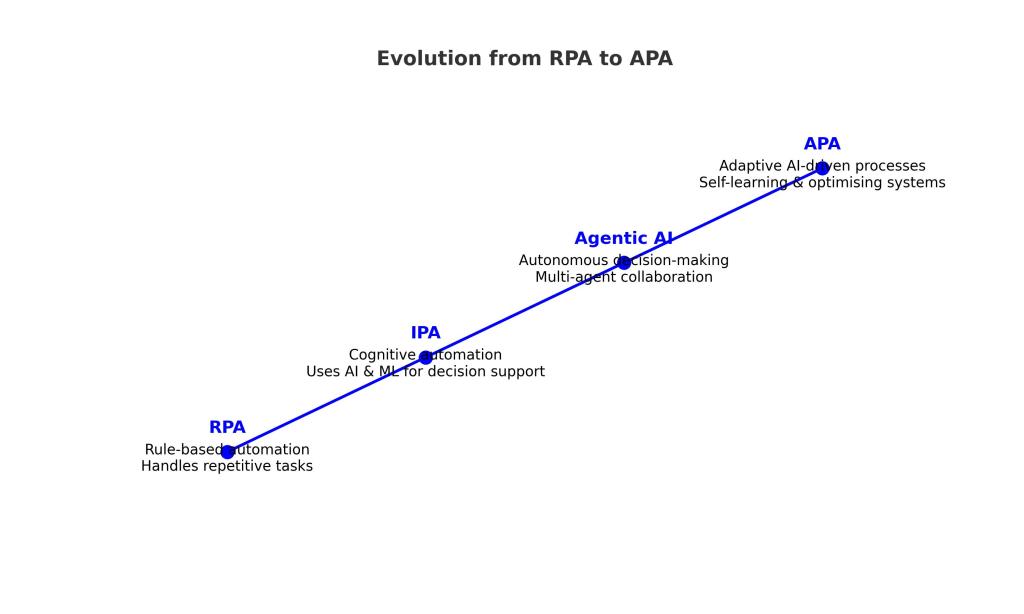
For years, Robotic Process Automation (RPA) has been a cornerstone of digital transformation, enabling businesses to streamline repetitive, rule-based tasks. However, the next evolution in automation is here—Agentic AI. Unlike traditional RPA, which follows predefined workflows, Agentic AI is adaptive, self-improving, and capable of independent decision-making.
This shift from rigid automation to autonomous, intelligent systems is redefining how organisations approach process optimisation. In this blog, we explore how Agentic AI is enhancing RPA, its incremental capabilities, and how current RPA providers are integrating this next-generation AI into their offerings.
The Cost of Siloed Collaboration in a World of AI-Driven Decision-Making
Beyond inefficiencies, misalignment across teams leads to:
• Delayed projects & rising costs – Without intelligent automation, decisions lag, and operational inefficiencies pile up.
• Lost innovation opportunities – When data is locked in silos, organisations struggle to identify and respond to market trends.
• Frustrated employees & disengaged teams – Studies show that 58% of employees cite siloed work environments as a major frustration.
Agentic AI: The Key to Breaking Down Silos
Unlike traditional AI, Agentic AI doesn’t just analyse data—it acts on it. It’s designed to autonomously coordinate tasks, enable real-time decision-making, and create interconnected intelligence across teams.
Let’s explore how forward-thinking organisations are leveraging Agentic AI to foster collaboration and streamline decision-making.
How Agentic AI is Revolutionising Collaboration
1. AI-Powered Autonomous Coordination
JPMorgan Chase has deployed Agentic AI in its legal and compliance operations, enabling AI agents to review contracts, extract insights, and proactively suggest amendments—all while seamlessly integrating feedback from multiple teams. The result? A 40% increase in efficiency and a significant reduction in compliance risks.
2. Predictive Risk Forecasting Through AI-Driven Markets
Leading tech firms like Google and Hewlett-Packard use AI-driven internal prediction markets to anticipate risks and optimise cross-team decision-making. Agentic AI enhances this by dynamically adjusting forecasts in real time, learning from new data inputs and employee feedback loops. Research from MIT Sloan suggests that AI-enhanced prediction markets improve forecasting accuracy by up to 35%.
3. AI-Augmented Decision Intelligence
Instead of siloed decisions, Agentic AI acts as an always-on advisor—processing vast datasets from different teams, identifying patterns, and suggesting optimal courses of action. DHL uses multimodal AI to optimise logistics operations, integrating inputs from finance, supply chain, and customer support, reducing operational costs by 15%.
Incremental Capabilities: How Agentic AI Enhances Traditional RPA
1️⃣ Context-Aware Decision Making
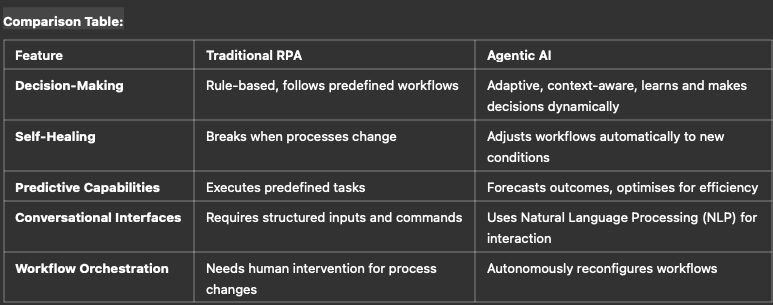
Traditional RPA is rule-based—it automates repetitive processes but lacks the ability to make decisions when confronted with variability. Agentic AI, however, can analyse context, learn from patterns, and adapt its responses dynamically.
💡 Example:
• In finance, an RPA bot may automate invoice processing by extracting and entering data into an ERP system.
• With Agentic AI: The system detects anomalies, predicts fraudulent transactions, and autonomously flags high-risk payments for review—something a static RPA bot cannot do.
2️⃣ Self-Healing Automation
One of the major limitations of RPA is its fragility—if a process changes (e.g., a UI update in a software system), bots often break. Agentic AI introduces self-healing capabilities, allowing automation to detect, diagnose, and adapt to changes without human intervention.
💡 Example:
• In IT service management, RPA bots automate password resets and user access provisioning.
• With Agentic AI: If a software interface changes, the AI dynamically updates its process map, reducing downtime and eliminating the need for frequent bot reprogramming.
3️⃣ Orchestration and Dynamic Workflow Optimisation
Traditional RPA requires humans to design and sequence automated tasks. Agentic AI, however, orchestrates and reconfigures workflows dynamically to improve efficiency.
💡 Example:
• A consulting firm uses RPA to automate client onboarding by collecting and verifying documents.
• With Agentic AI: The system assesses processing times, identifies bottlenecks, and redistributes workloads to optimise performance—without human intervention.
4️⃣ Conversational AI as an RPA Interface
Historically, RPA has relied on structured inputs and rigid workflows. Agentic AI introduces natural language processing (NLP) and multimodal interactions, enabling users to engage with automation via voice, text, or chat interfaces.
💡 Example:
• In customer service, RPA bots handle FAQs but struggle with complex queries.
• With Agentic AI: An AI-powered virtual assistant can interact with customers, process requests, and trigger the appropriate automation sequence dynamically.
5️⃣ Predictive and Prescriptive Analytics in Automation
While RPA executes tasks, it does not predict future trends or suggest improvements. Agentic AI enhances automation with predictive analytics, allowing businesses to forecast outcomes and take pre-emptive action.
💡 Example:
• In supply chain management, RPA processes orders, invoices, and logistics data.
• With Agentic AI: The system predicts inventory shortages, suggests supplier diversification, and autonomously places restock orders based on real-time market conditions.
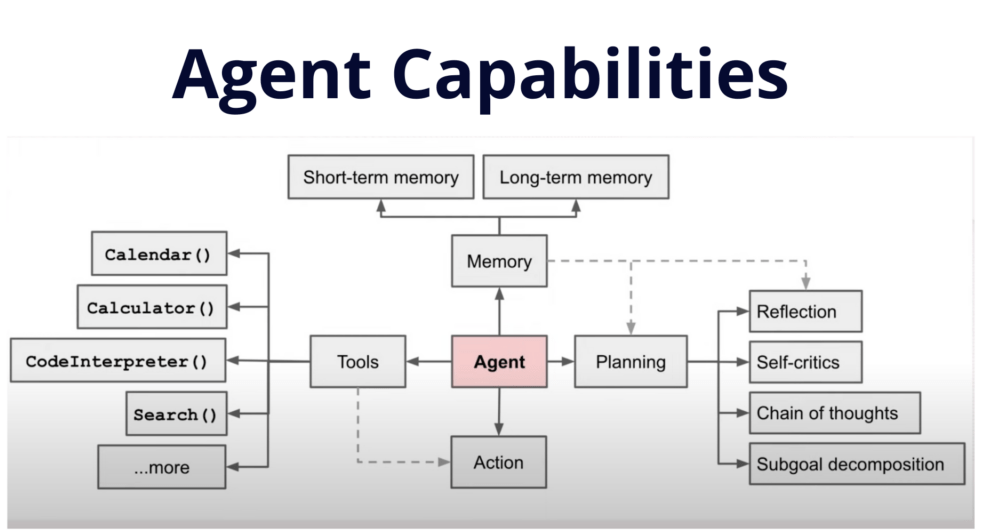
Integrating Agentic AI into Existing RPA Offerings
Key Approaches for Integration
1. AI-Augmented Decision-Making in Workflows
• Traditional RPA automates repetitive, rule-based tasks, but Agentic AI can make real-time decisions based on context.
• Example: AI-driven contract analysis—where RPA extracts key terms from legal documents, and Agentic AI assesses risk levels, suggests optimisations, or even initiates renegotiations with vendors.
2. Adaptive Process Automation
• Standard RPA bots fail when encountering edge cases or unexpected inputs. Agentic AI enables self-correcting workflows by learning from anomalies and adapting responses dynamically.
• Example: AI-powered financial reporting—RPA automates data extraction, while Agentic AI identifies inconsistencies, reconciles discrepancies, and suggests corrective actions without human intervention.
3. Conversational AI as a Process Orchestrator
• Integrate Agentic AI-powered assistants to oversee and guide RPA workflows in real-time, reducing human oversight.
• Example: A GenAI consultant that interacts with business leaders, understands strategic goals, and autonomously deploys or modifies RPA bots to optimise process workflows.
4. AI-Driven Insights and Continuous Optimisation
• Traditional RPA executes predefined tasks; Agentic AI can learn from historical data, predict inefficiencies, and recommend process improvements.
• Example: In supply chain consulting, AI continuously monitors logistics data, forecasts potential bottlenecks, and proactively adjusts RPA workflows to prevent delays.
5. Agentic AI in Knowledge Management and Compliance
• In consulting, knowledge repositories and compliance documentation are critical. AI can dynamically classify, summarise, and retrieve information while ensuring compliance.
• Example: AI-powered compliance auditing—RPA extracts regulatory updates, while Agentic AI analyses their impact on business operations and suggests necessary policy adaptations.
How Current RPA Players Are Approaching Agentic AI
🔹 UiPath
UiPath has shifted from rule-based automation to AI-powered hyperautomation. Its AI Fabric enables enterprises to integrate machine learning models into RPA workflows, allowing bots to make autonomous decisions.
Agentic AI Integration:
• AI-powered document processing with computer vision
• Self-learning bots that evolve based on usage patterns
• Process mining for workflow optimisation
🔹 Automation Anywhere
Automation Anywhere’s Generative AI-infused automation leverages LLMs (Large Language Models) to enhance RPA with decision-making capabilities.
Agentic AI Integration:
• Conversational AI for natural language process automation
• Cognitive bots that improve over time
• Adaptive exception handling in workflows
🔹 Microsoft Power Automate
Microsoft’s AI-driven automation suite is integrating GPT-based capabilities into its Power Automate ecosystem. The company is focusing on intelligent automation with deep integration into the Microsoft 365 ecosystem.
Agentic AI Integration:
• AI-powered email and document automation
• Self-healing workflows that adapt to process changes
• AI copilots to assist in automation strategy
Final Thoughts: The Future of AI-Enhanced RPA
The integration of Agentic AI into RPA is not just an incremental improvement—it is a paradigm shift in automation. As businesses move beyond static workflows, AI-powered adaptive automation will drive the next wave of efficiency, productivity, and innovation.
🔮 The future of RPA is not just about automating repetitive tasks, but about creating intelligent, autonomous systems that augment human decision-making. Consulting firms and enterprises that embrace Agentic AI-driven automation will gain a competitive edge in a rapidly evolving digital landscape.
Benefits of Agentic Process Automation
Agentic Process Automation (APA) offers a transformative approach to business automation by leveraging advanced AI capabilities. This approach provides several significant benefits that go beyond traditional automation methods.
- Enhanced Efficiency: APA dramatically improves operational efficiency by automating complex and dynamic workflows that were previously too challenging for traditional automation systems. AI agents handle tasks autonomously, reducing the need for human intervention and allowing employees to focus on core activities.
- Greater Flexibility: One of the standout features of APA is its high flexibility and adaptability. Unlike rule-based systems that require manual adjustments, APA uses AI agents capable of real-time decision-making. This adaptability ensures that the automated processes remain effective even as conditions change, maintaining optimal performance without constant human oversight.
- Cost Reduction: By minimizing the need for people to program your workflows and by reducing errors, APA helps organizations save on operational costs. The automation of complex workflows also means that tasks can be completed faster and more accurately, leading to significant cost savings.
- Continuous Improvement: A defining feature of APA is its capability for self-improvement. AI agents continuously learn from their interactions and outcomes, refining their processes and decision-making abilities over time. This iterative learning ensures that the system evolves and improves, becoming more effective with each cycle.
- Seamless Integration: APA offers seamless integration with a wide range of tools and platforms, from enterprise software to communication tools. This integration capability ensures that APA can be incorporated into existing IT infrastructure with minimal disruption, enhancing its utility and effectiveness across different business environments.
- Faster Implementation: Compared to traditional RPA, which often requires lengthy setup and manual configuration, APA allows for quicker deployment. Thanks to automated workflow construction and dynamic adaptability, businesses can implement APA more swiftly and accelerate their return on investment.
Agentic Process Automation represents a significant advancement in the field of digital automation, offering enhanced efficiency, flexibility, and accuracy. Its ability to integrate seamlessly with existing systems, continuously improve, and handle complex decision-making makes it an invaluable tool for modern businesses looking to stay competitive in an increasingly automated world.
While Agentic Process Automation (APA) offers numerous benefits, its implementation and maintenance present several challenges.
Measuring the Impact of AI-Driven Organisational Intelligence
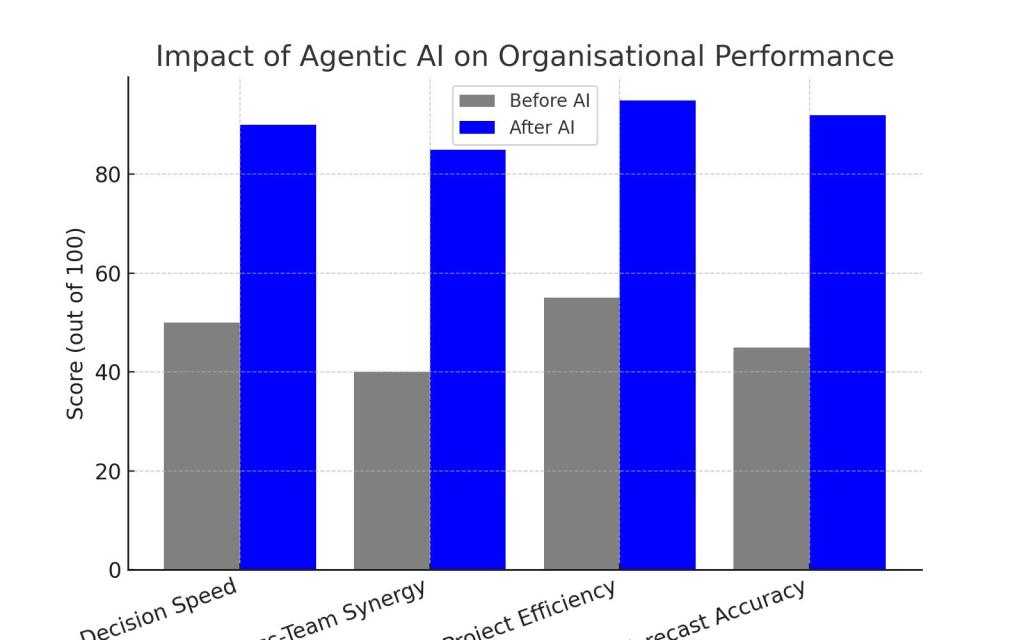
The success of an AI-enabled, decentralised decision-making model hinges on clear, measurable outcomes.
Key Metrics for Agentic AI-Driven Collaboration:
1. Decision-Making Speed – How much faster are strategic decisions executed?
2. Cross-Team Synergy Score – AI-driven analytics can track engagement between departments.
3. Project Efficiency Gains – Reduction in turnaround time for key deliverables.
4. AI Forecasting Accuracy – Measuring the effectiveness of AI-driven prediction models in identifying risks.
Challenges and Solutions
There are many challenges concerning APA. Addressing these challenges effectively is crucial for harnessing the full potential of APA.
- Reliable and Safe Decision-Making: Ensuring the accuracy and safety of decisions made by LLM-based agents is critical. The dynamic nature of APA means that AI agents are making real-time decisions that can significantly impact business operations. To address this challenge, rigorous testing and continuous monitoring of APA systems are essential. Implementing fail-safes and fallback mechanisms can handle errors gracefully. Additionally, making decision-making processes transparent and interpretable facilitates oversight, ensuring that stakeholders can understand and trust the actions taken by AI agents.
- Maintaining Human Control: Maintaining an appropriate level of human control is crucial to prevent over-reliance on automated systems. Clear protocols for human oversight, intervention, and validation of actions taken by APA systems need to be established. By defining specific points where human operators review and validate APA actions, organizations can ensure that critical decisions are cross-checked by human judgment. Training personnel to effectively monitor and manage APA operations is also vital to maintaining a balance between automation and human oversight.
- Integration with Existing Systems: Seamlessly incorporating APA into current IT infrastructure can be challenging, especially for organizations with complex or legacy systems. Developing proven integration strategies that prioritize compatibility and minimal disruption is essential. A modular and scalable approach can gradually incorporate APA into existing workflows, allowing for smooth transitions without major operational disruptions. Collaboration between IT and automation teams can also ensure that APA systems are well-integrated and supported within the broader technological ecosystem.
- Automation Bias: Over-reliance on automated systems can lead to automation bias, where users blindly trust the outputs of AI agents. This can result in overlooking potential errors or biases within the automated processes. To mitigate this risk, it is important to implement robust validation and monitoring mechanisms. Regular audits of APA outputs and decisions can help identify and correct biases. Fostering a culture of critical evaluation among users, where they are encouraged to question and validate automated decisions, can also help prevent blind trust in automation.
- Data Privacy and Security: Handling large volumes of data, including sensitive information, poses significant privacy and security challenges. Ensuring that APA systems comply with data protection regulations and implementing strong security measures is essential to protect against data breaches and unauthorized access. Encryption, access controls, and regular security audits can enhance data security. Additionally, establishing clear data governance policies can help manage and protect data effectively within APA systems.
- Skill Development and Training: Implementing APA requires a workforce skilled in AI Agents, LLMs, and advanced automation technologies. Organizations may face challenges in finding and training personnel with the necessary expertise. Investing in training programs and continuous learning opportunities for employees can help bridge the skill gap.
While the implementation of Agentic Process Automation presents challenges, addressing these through rigorous testing, continuous monitoring, clear protocols, robust integration strategies, and ongoing training can ensure the successful deployment and operation of APA systems. If we do so, APA can emerge as the future of Digital Automation
The Future: AI-Orchestrated Workflows Over Rigid Hierarchies
As AI becomes more agentic, organisations will shift from hierarchical, human-led decision-making to AI-orchestrated, adaptive workflows. The best-performing companies will be those that integrate AI as an autonomous decision partner, not just a backend analytics tool.
The question is no longer if AI can drive collaboration, but rather, how quickly organisations can embrace AI as a real-time, decision-making co-pilot.
Is your organisation ready to break the silos with Agentic AI? 🚀
Are you ready to upgrade your RPA strategy with Agentic AI? 🚀
Would love to hear your thoughts—how do you see AI transforming automation in your industry? Let’s discuss in the comments! 💬
 Genesis: Human Experience in the Age of Artificial Intelligence | Synthesis: The Superintelligence Protocol
Leave a comment