

The software development landscape is undergoing a seismic shift, driven by the rise of AI coding assistants like Replit Agent, GitHub Copilot, Cursor AI, and others. These tools are more than just helpful companions; they are redefining the rules of coding, accelerating project timelines, reducing costs, and empowering developers to achieve more in less time.
In this blog, we’ll explore the detailed use cases of AI coding assistants, focusing on Replit Agent, and highlight how they bring measurable time and cost savings, along with significant productivity gains.
What Are AI Coding Assistants?
AI coding assistants are intelligent tools powered by advanced natural language processing and machine learning models. They assist developers in writing, debugging, and maintaining code. Tools like Replit Agent take this a step further by offering an end-to-end development experience, from environment setup to deployment.
Key Use Cases and Benefits
1. Automating Repetitive Coding Tasks
• Use Case: Automating boilerplate code generation, setting up development environments, and creating repetitive data processing scripts.
• Example: A team building a web application can use Replit Agent to generate CRUD operations for their backend API in minutes.
• Time Savings: Reduces setup and boilerplate tasks by up to 80%, saving 4–6 hours per developer per week.
• Cost Savings: For a team of 5 developers earning $100/hour, this equates to approximately $10,000 saved per month.
3. Automation of Repetitive Tasks
• Impact: AI coding agents automate mundane and repetitive tasks, such as testing, deployment scripts, or integration of APIs, allowing developers to focus on more critical features.
• Real-World Examples:
• Spotify:
• Automated backend API integrations using AI, reducing manual work hours by 50%.
• Citi:
• Streamlined financial data processing scripts using AI coding tools, enabling them to reduce deployment time by 60%.
• Cost Savings:
• A medium-scale organisation saves approximately $100,000 annually by automating repetitive coding tasks.
• Productivity Gains:
• Teams gain an extra 10–15 hours weekly per developer to focus on high-value tasks.
2. Accelerating Prototyping
• Use Case: Quickly building minimum viable products (MVPs) to test new ideas.
• Example: A startup exploring a new fintech product can rely on Replit Agent to rapidly assemble a prototype with working features, such as user authentication and payment integration.
• Time Savings: Prototypes that typically take 2–3 weeks can be completed in 4–5 days.
• Productivity Gains: Faster time-to-market allows teams to iterate based on user feedback sooner, potentially capturing market opportunities earlier.
3. Enhanced Debugging and Code Review
• Use Case: Identifying bugs, suggesting fixes, and reviewing code quality.
• Example: Replit Agent can pinpoint errors in a Python application’s logic and suggest optimised solutions, even explaining the changes for better understanding.
• Time Savings: Debugging that might take hours can be reduced to minutes.
• Cost Savings: Reduced downtime and faster bug resolution prevent delays, saving potentially thousands of dollars in delayed project timelines.
2. Debugging and Error Reduction
• Impact: AI agents identify and fix bugs in real-time, reducing the cost of late-stage error correction and improving software reliability.
• Real-World Examples:
• Facebook:
• Deployed AI for code review and debugging, reducing critical bugs by 25% in large-scale deployments.
• Stripe:
• AI-powered debugging tools improved deployment readiness time by 30%.
• Cost Savings:
• For large-scale projects, debugging costs are reduced by 30–50%, saving up to $50,000 annually for a mid-sized software development team.
• Productivity Gains:
• Developers save 15–20% of their weekly hours previously spent on debugging.
4. Supporting Cross-Functional Collaboration
• Use Case: Bridging the gap between technical and non-technical team members.
• Example: A product manager can describe a feature in plain English, and Replit Agent generates the foundational code for developers to refine.
• Impact: This fosters better alignment between business and technical teams, reducing the back-and-forth often seen in agile sprints.
5. Upskilling Developers
• Use Case: Helping junior developers learn best practices and write better code.
• Example: Replit Agent not only generates code but explains why certain patterns or frameworks are used, providing an educational component.
• Long-Term Benefits: Builds a more competent team over time, reducing reliance on external training programmes.
6. Impact on Developer Roles
• Skill Evolution: Developers are transitioning into roles requiring strategic thinking, domain expertise, and collaboration with AI tools.
• Job Polarisation: While AI reduces the need for entry-level coding, it increases demand for AI-literate developers who can supervise and enhance AI models.
• Emerging Opportunities: New roles like “Prompt Engineers” or “AI Augmentation Specialists” are becoming relevant.
7. Ethical and Security Considerations
• Code Ownership: Questions arise about intellectual property for AI-generated code.
• Bias and Vulnerabilities: AI models trained on biased or insecure codebases may propagate these issues.
• Regulatory Compliance: Ensuring AI-generated code adheres to industry standards and legal requirements is crucial.
7. Ethical and Security Considerations
• Code Ownership: Questions arise about intellectual property for AI-generated code.
• Bias and Vulnerabilities: AI models trained on biased or insecure codebases may propagate these issues.
• Regulatory Compliance: Ensuring AI-generated code adheres to industry standards and legal requirements is crucial.
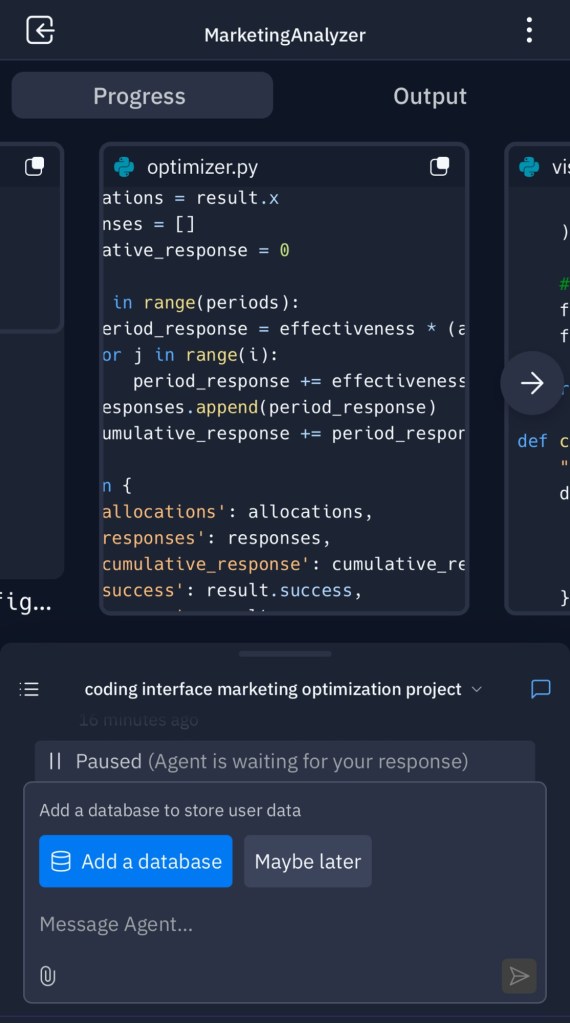
Here’s me prompting the Replit Agent to clone a popular foodie website (ChiefEater) which it did 20s with impressive features such as a recommender, social integration and geolocation – Replit suggested features to add to the build rather intuitively.

 Genesis: Human Experience in the Age of Artificial Intelligence | Synthesis: The Superintelligence Protocol
Leave a comment