

The future of work in 2050 is a subject of much speculation, with experts offering a range of perspectives. The sources don’t provide a definitive picture. However, they offer valuable insights into the trends shaping the future of labour. This is particularly evident in the impact of artificial intelligence (AI).
Daniel Susskind is a leading voice in this discussion. He argues in his book “A World Without Work” that AI will progressively take over more tasks. This shift will lead to widespread technological unemployment. He highlights the “substitution force”, where machines replace humans in jobs because they’re cheaper, better, or faster. Susskind acknowledges the “complementary force”. This force involves new jobs created due to increased productivity. However, he argues that this might not be enough to offset job losses as AI becomes increasingly sophisticated.
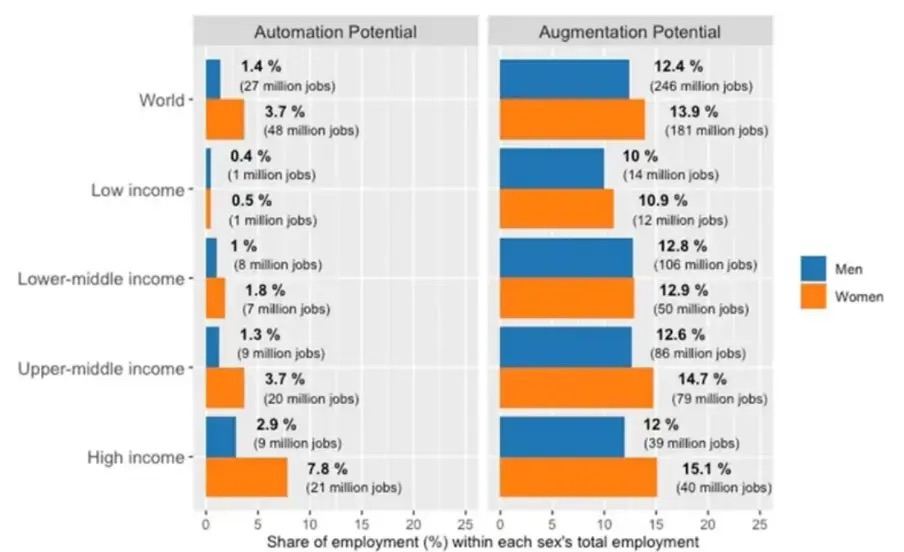
Susskind anticipates a transition from frictional to structural technological unemployment. Initially, there may be jobs available, but workers might lack the necessary skills or face geographical and identity mismatches. Eventually, he predicts a scenario. There simply won’t be enough jobs for everyone. AI will encroach on a wider range of tasks.
Other experts, while acknowledging AI’s disruptive potential, offer more optimistic perspectives. PwC’s 2024 AI Jobs Barometer suggests that AI’s impact might be similar to the internal combustion engine. You can find a summary podcast here: https://lnkd.in/gYmUYmdn condensed using NotebookLM.
It might cause disruption. However, it will ultimately create more jobs than it displaces. The report highlights how AI can redefine existing roles and even generate entirely new industries. Workers who adapt and harness AI’s power are likely to see increased productivity, bargaining power, and higher wages.
Here’s a really interesting timeline (beyond 2050) that researchers like Nicky Dries has come up with. Fascinating!

Looking ahead to 2050, the sources and experts suggest several key trends:
●Increased Automation and Human-AI Collaboration: AI will likely handle a larger share of tasks. However, the emphasis will be on human-AI collaboration. Workers will need to develop skills to work effectively alongside AI systems.
●Shifting Skill Demands: Cognitive skills such as analytical and creative thinking, along with technological literacy, will be highly sought after. Lifelong learning will be essential for adapting to evolving skill requirements.
●The Importance of Purpose and Meaning: As work becomes less central to life, alternative sources of fulfilment will become crucial. Society will need these alternatives for contribution.
Susskind proposes the idea of a “Big State.” It actively redistributes income and wealth. This redistribution may happen through measures like a Universal Basic Income (UBI). He suggests that the state should help shape how people spend their time. This involvement is meant to ensure a sense of meaning and purpose. However, he acknowledges that such interventions raise concerns about potential overreach and the need for careful consideration.

While the sources offer varied perspectives, they agree that the transition to an AI-driven world requires proactive measures. These include:
●Investing in Upskilling and Reskilling Programs: Equipping workers with the skills needed to thrive in an AI-augmented workplace.
●Encouraging Responsible AI Development: Prioritising ethical guidelines and regulations to ensure AI benefits society as a whole.
●Strengthening Social Safety Nets: Providing support and resources for those displaced by automation.
The future of work in 2050 remains uncertain, but it’s clear that AI will play a defining role. The choices we make today will shape the future of work. These include decisions in technological development, policy-making, and individual adaptation. These choices will decide if the future brings widespread unemployment and a loss of purpose. Alternatively, we may see increased productivity, new opportunities, and greater human flourishing.
The future of work is a topic that sparks both excitement and anxiety. Will robots steal our jobs? Will we all be working from beachside hammocks, sipping cocktails delivered by drones? While the reality is likely to be less dramatic, one thing is clear: the way we work is undergoing a radical transformation.
Let’s take a journey through time, exploring how human work will evolve in the coming decades:
Job Creation and Transformation
1. New Roles: While AI will displace certain jobs, it will also create new opportunities that demand different skill sets. Roles like AI ethicists, AI trainers, and AI project managers will become increasingly important.

Human-Centric Jobs: Professions that rely on distinctly human qualities—such as teachers, healthcare workers, and creative professionals—will continue to thrive. The rise of AI in healthcare could create roles focused on AI-aided diagnostics. There will be positions in telemedicine. Personalized patient care roles could also emerge.

Economic Growth: AI could inject an additional $13 trillion into the global economy by 2030. This injection could boost global GDP by as much as 16%. This surge will stem from AI-driven automation and radical innovations in products and services.
2025-2030: The Dawn of Widespread AI Adoption
This period will witness the rapid adoption of artificial intelligence (AI) across industries. AI will spread quickly, much like the internet revolutionised the late 20th century. Businesses will increasingly rely on AI for data analysis, process automation, and customer service. This will lead to significant changes in skill demand. There will be a greater emphasis on technological literacy. Analytical thinking and AI-related skills will also become more important. Workers will need to adapt quickly, embracing lifelong learning and upskilling to remain competitive.
●Job displacement will be a concern, particularly in roles involving repetitive tasks. However, new jobs will emerge, often requiring collaboration with AI systems.
●Workforce training and reskilling initiatives will become critical for individuals and organisations. Governments and businesses will need to invest heavily in education and training programmes to bridge the skills gap.
●The concept of “work” itself may begin to evolve, with some individuals exploring alternative career paths, such as in the arts, volunteering, or personal development.
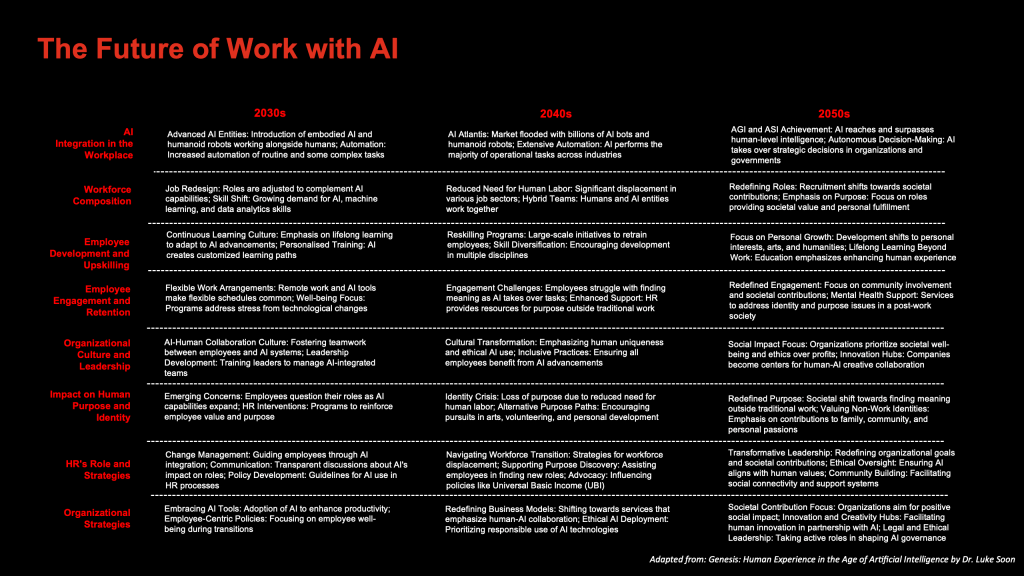
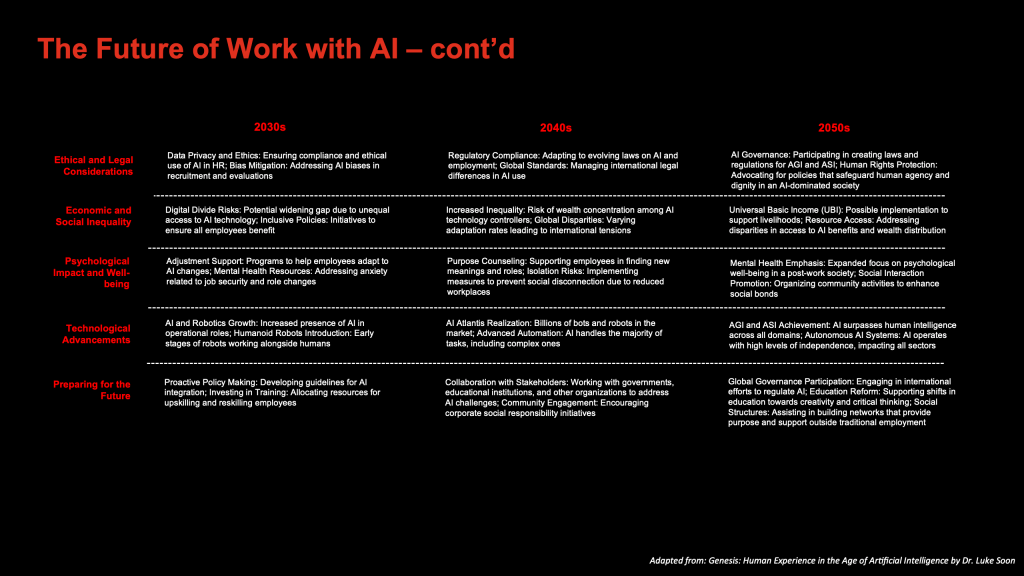
Here’s a more detailed year by year prediction from my Genesis book on the Future of Work trends, with major milestones from 2024-2030
2024: The Year of AI Upskilling and Initial Disruptions
• AI Upskilling Initiatives: Organizations are recognizing the need for improved AI skills. 89% of respondents acknowledge this need. However, only 6% have begun upskilling in a meaningful way.
• Rapid Adoption of AI Technologies: The demand for new capabilities is creating a scramble to upskill the workforce. There are significant advancements in AI technology. This includes the release of powerful models like GPT-5 and Claude 4.
• Initial Job Displacement: More than 30% of all workers could face disruption of at least 50% of their occupation’s tasks. This disruption comes from generative AI.
2025: Transition and Adaptation
• Job Creation and Displacement: AI and automation are expected to create 97 million new jobs worldwide but also displace 85 million jobs . This year marks a critical period for workforce adaptation and reskilling.
• Sector-Specific Transformations: Various sectors, including healthcare, finance, and manufacturing, are experiencing significant changes. For instance, AI-driven diagnostics in healthcare and predictive analytics in finance are revolutionizing these industries .
2026: Accelerated Automation and Workforce Planning
• The adoption of AI will accelerate by 2026. Up to 30% of work hours globally may be automated. This will necessitate advanced workforce planning to predict future talent needs and bridge skills gaps.
• Global Economic Impact: AI could inject an additional $13 trillion into the global economy by 2030. This highlights the economic benefits of AI adoption.
2027: Ethical Considerations and Policy Development
• Ethical AI Use: AI continues to integrate into workplaces. Ethical considerations around privacy are crucial. Bias and job displacement also require attention. Organizations must address these issues effectively. Governments and organizations must develop policies to ensure fair and responsible AI use.
• Policy Implementation: The Biden administration’s AI executive order and other regulatory frameworks will be crucial in managing the transition and protecting workers’ rights.
2028: AI Transformation in the Workplace
• AI in Various Roles: By 2028, AI will be deeply integrated into different job roles. It will enhance efficiency and drive innovation. This integration will require continuous learning and adaptation from the workforce.
• New Job Roles: Remote work will rise, powered by AI-driven collaboration tools. This change will shift job markets worldwide. It will create new roles focusing on overseeing AI technologies rather than performing manual tasks.
2029: Workforce Transformation and Lifelong Learning
• Workforce Transformation: The workforce will undergo significant transformation. There will be a focus on lifelong learning. Technical skills development will be prioritised. Organizations and educational institutions will play a pivotal role in this transition by offering training programs to equip individuals with necessary skills.
• Continuous Learning Culture: We must foster continuous learning. This will be essential to navigate challenges and seize AI opportunities. This includes promoting STEM education and ensuring equitable access to reskilling opportunities.
2030: Full Integration and Economic Growth
• Full AI Integration: By 2030, AI will be fully integrated into the global economy. This change will have significant impacts on job markets and organizational hierarchies. The total economic benefits from AI and automation could add up to $15.7 trillion globally .
• Sustainable Workforce: The future workforce will need to adapt to coexist with AI. Workers will leverage the technology to augment human capabilities rather than compete with them. This sustainable approach will ensure that the benefits of AI are distributed fairly across society.
2030-2040: AI as a Collaborative Partner
As AI matures, it will transition from a tool to a collaborative partner. The focus will shift from simply automating tasks to leveraging AI for complex problem-solving, creativity, and innovation.
●Human-AI collaboration will become the norm across various sectors. Workers will need to develop skills in communication, critical thinking, and ethical decision-making to effectively work alongside AI systems.
●The demand for specialised expertise in areas like AI ethics, data privacy, and AI regulation will increase. New industries may even emerge around these areas.
●Discussions around the social and economic impact of AI will intensify, leading to new policies and regulationsaimed at ensuring equitable distribution of AI’s benefits and mitigating potential risks.
The 2050s: The Age of Augmented Intelligence
By the 2050s, AI will likely be deeply integrated into our lives, transforming not just the way we work but also how we live and interact with the world. This era might be characterised by augmented intelligence, where AI seamlessly augments human capabilities rather than replacing them.
●Work will likely be more flexible and adaptable, with individuals potentially having multiple careers throughout their lives.
●The emphasis will be on creativity, innovation, and complex problem-solving – skills that AI can assist but not fully replicate.
●Lifelong learning will become an absolute necessity, with individuals constantly updating their skills to keep pace with technological advancements.
●Discussions surrounding universal basic income and alternative economic models may gain traction as the nature of work continues to evolve.
A world without work? What happens when humans lose their Purpose?
Ultimately, the evolution of human work will depend on how we choose to adapt and leverage AI’s potential. The future holds both challenges and opportunities. We can navigate the shifting sands of work by embracing lifelong learning. We should also foster collaboration. By prioritising human ingenuity, we create a future where technology empowers us to achieve more than ever before.
A world without human purpose is a recurring concern. Humanity must be aware of the high probability of an “identity crisis.” AI will take over more tasks traditionally performed by humans. This may lead to feelings of displacement and lack of meaning. To address this, they suggest:
●Redirecting Technological Development: Instead of focusing solely on automation, technology should enhance human skills. It should also create new opportunities.
●Promoting “Leisure Planning” Policies: As work becomes less central to life, the state might have to become more actively involved. The goal is to help people find purpose and fulfilment in their free time.
●Fostering a Culture of Lifelong Learning: Continuous learning and skill development are essential. Individuals need these to adapt to the changing demands of the job market. They also help people discover new passions.
●Encouraging Societal Contributions: Finding meaning and purpose may shift from traditional work to contributions to family, community, and personal passions.
The sources suggest that the transition years leading up to 2030 are critical. These years are essential for laying the groundwork for adapting successfully to an AI-driven future. Actions taken during this period should focus on:
●Upskilling and Reskilling the Workforce: Providing workers with the necessary training and education to thrive in an AI-augmented workplace.
●Encouraging Responsible AI Development and Use: Establishing ethical guidelines and regulations to ensure AI is used for good and does not exacerbate inequality or social divisions.
●Creating a Supportive Social Safety Net: This could include measures like UBI, along with worker protections and safety nets to help those displaced by automation.
The Role of Government
Governments worldwide are increasingly recognising the potential impact of AI on the job market and are beginning to formulate policies to address the challenges and opportunities it presents. The sources highlight a range of approaches being considered and implemented:
Skills Development and Retraining: Many governments are focusing on upskilling and reskilling initiatives to equip workers with the necessary skills for an AI-driven economy. Examples include:
●Singapore: The government is developing a “temporary financial support scheme” to support individuals displaced by technological advancements, along with robust training and reskilling programs within the SkillsFuture ecosystem.
●United Kingdom: The National Retraining Scheme was launched with a £100 million investment. It aims to train workers, particularly those affected by AI and automation.
●United States: The Biden administration announced measures to promote responsible AI innovation. These measures include funding for research and development. The administration also issued an executive order addressing AI’s impact on jobs, safety, and ethics.
Policy Incentives and Regulations: Governments are exploring policies to encourage responsible AI development. They also aim to incentivise companies to invest in human capital. These include:
●Tax Policies: Experts suggest setting effective tax rates for capital higher than those for labour. This encourages companies to prioritize human workers over automation.
●Displacement Taxes: Some propose a tax on companies that displace workers due to AI, with subsidies for retraining initiatives.
●Regulation of AI: The European Parliament is working on the AI Act. It aims to regulate the technology. The Act addresses risks like privacy violations and worker protection.
●Social Safety Nets: The idea of a Universal Basic Income (UBI) is gaining traction. It is considered a potential safety net for those displaced by AI. However, its implementation faces significant challenges.
Singapore’s temporary financial support scheme is viewed as a preliminary measure. It aims to provide a safety net for those affected by AI-driven job displacement.
However, the sources acknowledge the high costs and potential drawbacks of UBI. There’s no clear indication of any country actively implementing a full-fledged UBI program.
International Collaboration: The sources emphasize the need for collaboration between governments, businesses, and workers to navigate the AI revolution successfully. This includes:
●Sharing best practices for AI adoption and workforce development.
●Developing global standards for ethical AI development and use.
●Coordinating efforts to ensure the benefits of AI are shared equitably.
The specific policies and approaches vary across countries, reflecting different economic contexts, political landscapes, and societal priorities. However, people increasingly recognize the need for proactive measures to address the potential disruption caused by AI. These measures focus on skills development, responsible AI development and use, and social safety nets. The sources highlight that the years leading up to 2030 are crucial. They are essential for laying the groundwork. This groundwork aims for a future where AI empowers workers rather than displacing them.
UBI. Will it save us? Will it save jobs?
The idea of a Universal Basic Income (UBI) as a response to AI-driven job displacement is a recurring theme in the sources. There is no consensus on whether UBI is the definitive solution. However, many experts view it as a potential tool. It may help mitigate the social and economic upheaval caused by widespread automation.
Here’s a summary of the arguments for and against UBI, and the potential steps required for its adoption:
Arguments for UBI:
●Provides Economic Security: UBI offers a safety net for those who lose jobs due to AI. It ensures basic financial stability and reduces poverty.
●Encourages Innovation and Entrepreneurship: With a guaranteed income, individuals might feel more confident. This might lead them to pursue risky ventures. These ventures could potentially result in new businesses and industries.
●Reduces Inequality and Promotes Social Cohesion: By redistributing wealth, UBI can help address income disparities exacerbated by AI-driven job losses.
●Simplifies Welfare Systems: UBI can replace complex, means-tested programs, reducing administrative costs and stigma.
●Empowers Workers: UBI could provide workers with more bargaining power, allowing them to negotiate better wages and working conditions.
Arguments Against UBI:
●High Cost and Fiscal Sustainability: Implementing UBI, especially in developed countries, would require significant government spending. This could potentially lead to higher taxes or cuts in other essential programs.
●Potential for Inflation: A sudden influx of cash into the economy could trigger inflation. This inflation may diminish the purchasing power of the basic income.
●Uncertainty Regarding Job Market Effects: Some argue that UBI could disincentivize work. This could lead to labour shortages. Others believe it could empower workers to demand better jobs.
●Implementation Challenges: Determining the appropriate level of basic income would be complex. Setting up an effective distribution system is also challenging. Additionally, preventing fraud is another complicated task.
●Political Feasibility: Gaining widespread political support for such a radical policy shift remains a significant challenge.
Steps Required for UBI Adoption:
The sources, while acknowledging UBI as a potential solution, don’t provide a detailed roadmap for its adoption. However, they suggest several crucial steps:
●Further Research and Pilot Programs: Conducting more research and implementing pilot programs in various contexts would be essential to assess UBI’s effectiveness, potential challenges, and optimal implementation strategies.
●Public Discourse and Education: Fostering open discussions about UBI, its potential benefits and drawbacks, and its implications for society would be crucial for building public understanding and support.
●Political Will and Consensus Building: Gaining political buy-in from policymakers, stakeholders, and the public would be necessary for implementing UBI on a large scale.
●Addressing Funding Concerns: Identifying sustainable funding sources for UBI without compromising other essential social programs or creating undue economic strain would be critical.
●Ensuring Equitable and Efficient Distribution: Designing an effective and fair distribution system that prevents fraud and reaches those who need it most would be paramount.
The debate on UBI’s effectiveness in addressing AI-driven job displacement is ongoing.Further research, pilot programs, and open discussions are necessary to assess its feasibility and develop robust implementation strategies.
The coming years will be crucial for shaping a future where AI empowers humanity rather than leading to widespread disruption and a loss of purpose.
 Genesis: Human Experience in the Age of Artificial Intelligence | Synthesis: The Superintelligence Protocol
Leave a comment