

21st Dec 2024. OpenAI has recently unveiled its latest reasoning model, o3, along with a smaller variant called o3-mini. This release marks a significant advancement in AI capabilities, particularly in the realm of reasoning and problem-solving
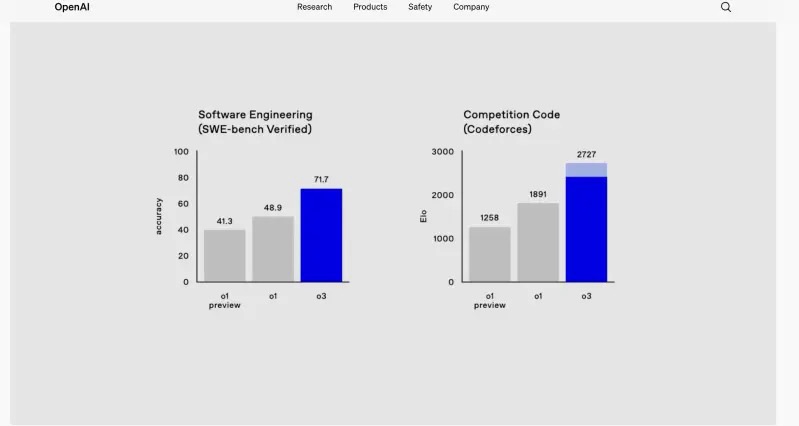
- Adaptive Thinking Time: • A standout feature of the o3 models is their ability to adjust the amount of reasoning time based on the difficulty of the problem. Users can set the models to low, medium, or high compute settings, with higher settings leading to better performance on tasks .
- Benchmark Performance:
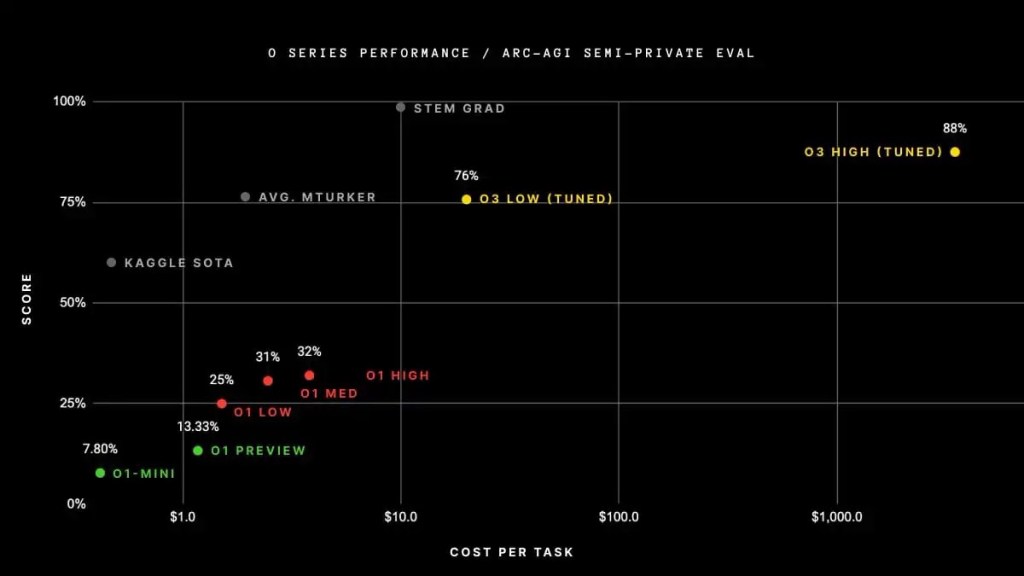
• The o3 models have achieved record-breaking scores on various benchmarks. For instance, o3 scored 87.5% on the ARC-AGI benchmark in high compute mode, which evaluates an AI system’s ability to acquire new skills outside its training data.
• On the 2024 American Invitational Mathematics Exam, o3 scored 96.7%, missing just one question. It also achieved 87.7% on the GPQA Diamond benchmark for expert-level science problems and set a new record on EpochAI’s Frontier Math benchmark by solving 25.2% of problems . - Safety and Ethical Considerations:
• OpenAI is conducting rigorous safety testing and red-teaming for the o3 models to ensure they align with ethical guidelines and minimize risks such as deception and misuse .
• The company has introduced a new technique called “deliberative alignment,” which requires the AI to process safety decisions step-by-step, actively reasoning about whether a user’s request fits OpenAI’s safety policies . - Public Availability:
• Currently, the o3 models are not widely available to the public. OpenAI is granting early access to safety researchers for testing purposes. The plan is to launch o3-mini by the end of January 2025, followed by the full o3 model at a later date
- Benchmark Performance:
Key Features of o3 and o3-mini
1. Reasoning Capabilities:
• The o3 models are designed to perform complex reasoning tasks more effectively than their predecessors. They can break down instructions into smaller tasks, which helps in producing stronger outcomes and providing explanations for their reasoning process.
• The models employ a “private chain of thought” process, where they pause before responding to consider related prompts and explain their reasoning along the way. This method helps in achieving more reliable results in domains such as physics, science, and mathematics .
The o3 model by OpenAI is a significant advancement in the field of AI, particularly in the context of Artificial General Intelligence (AGI). OpenAI defines AGI as “highly autonomous systems that outperform humans at most economically valuable work” . The o3 model represents a step closer to achieving AGI, but it is not yet fully there.
Levels of AGI and o3’s Role
OpenAI’s approach to AGI can be understood through five levels of progress:
1. Basic AI Capabilities:
• At this level, AI systems can perform specific tasks but lack the ability to generalize across different domains.
• The o3 model, however, demonstrates enhanced reasoning capabilities, which is a step beyond basic AI capabilities. It can perform complex reasoning tasks and adapt to novel problems more effectively than its predecessors.
2. Specialized AI:
• AI systems at this level are highly proficient in specific domains but still require extensive training and fine-tuning for each new task.
• The o3 model shows significant improvements in specialized tasks, such as scoring 96.7% on the 2024 American Invitational Mathematics Exam and 87.7% on the GPQA Diamond benchmark for graduate-level science questions .
3. Generalized Reasoning:
• This level involves AI systems that can reason across different domains and adapt to new tasks with minimal additional training.
• The o3 model approaches this level by demonstrating the ability to solve problems it has never encountered before, as evidenced by its performance on the ARC-AGI benchmark, where it scored 87.5% in high-compute mode . This benchmark tests an AI’s ability to learn new skills on the fly, which is a critical aspect of generalized reasoning.
4. Human-Level Performance:
• At this level, AI systems can perform any intellectual task that a human can, often surpassing human performance in many areas.
• While the o3 model shows impressive capabilities, it still falls short of consistent human-level performance across all tasks. For instance, it excels in certain benchmarks but struggles with others, indicating that it is not yet at the human-level performance stage.
5. Superhuman Performance:
• This is the highest level of AGI, where AI systems can perform intellectual tasks far beyond human capabilities.
• The o3 model does not yet achieve superhuman performance, but its advancements suggest that future iterations could potentially reach this level.
Conclusion
The o3 model represents a significant milestone in AI development, bringing us closer to AGI by demonstrating advanced reasoning and adaptability. However, it is still not fully at the level of AGI, as it has not yet achieved consistent human-level performance across all tasks and domains. The model’s performance on benchmarks like ARC-AGI indicates that it is making strides towards generalized reasoning, which is a critical component of AGI

 Genesis: Human Experience in the Age of Artificial Intelligence | Synthesis: The Superintelligence Protocol
Leave a comment