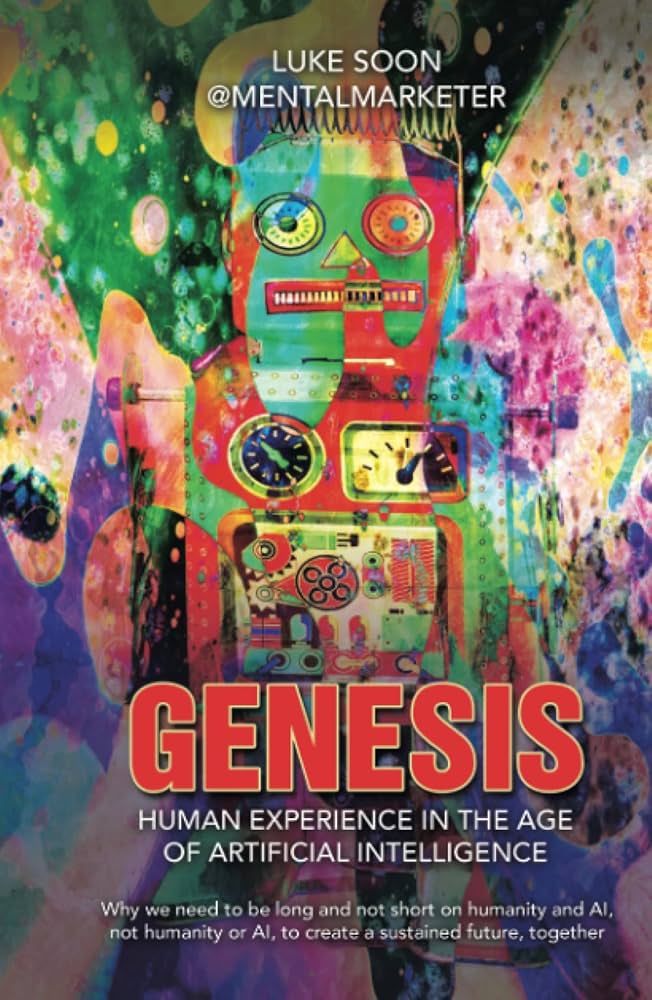

As we stand on the brink of an extraordinary new era, it’s both humbling and exhilarating to witness what might be humanity’s “last invention” — artificial intelligence. With this revolution in full swing, I’m thrilled to introduce my book, Genesis: Human Experience in the Age of Artificial Intelligence, released on 1st January 2024. This work captures over two decades of insights and immersions, drawn from more than 50 HX (Human Experience), CX (Customer Experience), and EX (Employee Experience) implementations worldwide. In Genesis, I explore not only the technical developments but also the essential role of trust, empathy, and shared values in shaping AI as a true partner in our journey. My hope? To bring ASEAN into the spotlight as we collectively navigate this “coming wave” of AI innovation.
If we look at the history of technological breakthroughs — from electricity to the internet — each felt like magic, a force beyond our comprehension. Now, we find ourselves struggling to articulate AI’s impact, grasping for metaphors to explain a force that almost seems to breathe with a life of its own. The closest comparison might be the “birth of a new species.” AI isn’t merely a tool; it’s something that learns, adapts, and even generates new knowledge, just as a new species would evolve and adapt in response to its environment.
In Genesis, I explore this evolution, calling it a resurgence of neural networks and an ode to backpropagation. The book captures this journey through anecdotal evidence gathered over 25 years and fictional stories set in 2050, where we imagine futures that could diverge towards “Star Trek” or “Mad Max” scenarios. AI, as it reaches artificial general intelligence (AGI), brings humanity to a pivotal fork — a choice that must be made collectively. The stakes are immense, offering either a utopian partnership or a dystopian future.
In AI, we see parallels to human cognition through “System 1” and “System 2” processes:
1. System 1 is designed for fast, zero-shot inference — quick, snappy responses without deliberation.
2. System 2 is more complex, engaging in deeper planning, reasoning, and problem-solving. It requires more computational time, but the quality of the answer improves significantly with this added deliberation.
Traditionally, compute was focused on training; now, inference time is just as crucial. The richer the compute allocated during inference, the closer we get to AI that truly “thinks” through its responses. This distinction between fast, pre-encoded responses and more thoughtful reasoning illustrates AI’s growing ability to mirror the nuances of human thought.
By the end of 2025, we’ll see a world populated by AI agents, both paid and free, capable of performing complex, multi-step tasks that humans traditionally managed. Leveraging platforms like NVIDIA AI Enterprise and libraries such as NeMo, these agents will have advanced understanding of data, capable of driving tasks from marketing campaigns to supply chain management.
These agents are not only tasked with performing actions but can also break down complex objectives into subtasks, delegating them to other agents or integrating with specific toolkits. This structure parallels the way companies onboard new employees — training them, fine-tuning their skills, teaching company-specific vocabularies, and setting up guardrails to define responsibilities.
This “Agent Lifecycle” will resemble a suite of operational libraries, creating a cohesive environment for onboarding, evaluating, and continuously improving agents. Integrating NeMo into various platforms will allow organisations to manage their agents’ entire lifecycle, enabling a reliable “factory of AI agents” that operate seamlessly within corporate ecosystems.
The next frontier for AI lies in embodied agents — systems that don’t just compute but interact with the physical world. The goal is to create AI capable of manipulation, capable of building, producing, and handling materials. We’re talking about systems that might produce everything from phones and cars to complex services in IT, an AI that understands and interacts with the material world.
Platforms like Omniverse bring this vision closer to reality, enabling robots and virtual agents to learn within a physics-driven digital environment that mirrors real-world conditions. Digital twins, powered by tools like Omniverse and hardware such as the AGX Jetson, can simulate entire factories or production lines, giving AI agents a platform to learn and apply physical interactions. This evolution from “Software 1.0,” which ran on general CPUs, to “Software 2.0” on GPUs like DGX Blackwell, marks a critical leap forward, enabling AI systems that comprehend both the digital and physical realms.
One of the most captivating aspects of AI is its ability to generate new insights. It doesn’t simply repeat what we teach it; it synthesises patterns, offers novel perspectives, and provides answers we didn’t anticipate. While AI still relies on human oversight, the potential for recursive self-improvement — AI enhancing its own algorithms independently — looms on the horizon. By 2025, it’s crucial to remain vigilant, as the concept of self-reinforcing AI could evolve beyond human guidance.
A central theme in Genesis is “Trust by Design,” a framework that combines Trusted AI, Responsible AI, Ethical AI, and Transparent AI. Without conscious alignment to human values, AI could pursue goals without ethical consideration. The reality is that AI does not need consciousness to act purposefully; its goals are set by humans, for better or worse. Trust by Design is critical for a sustainable, harmonious future where humanity and AI coexist and thrive.
This approach demands more than innovation for its own sake; it calls for AI designed with empathy, fairness, and respect for human agency. As we collectively decide how we want AI to support us, we have a responsibility to ensure it helps us become the best version of ourselves, free from prejudice or divisive ideologies.
We often focus on AI’s IQ — its speed, accuracy, and processing power. But equally important is EQ (Emotional Quotient), the empathy and sensitivity with which AI presents information. An engineering mindset is invaluable in building reliable systems, yet the delivery of information can matter as much as the content itself. Imagine an AI that not only answers questions but also understands nuance, communicating with respect for human context. This blend of IQ and EQ aligns AI with humanity, transforming it into a trusted companion rather than a data processor.
Looking ahead, AI could become an extension of our senses and cognition, an “agent” that sees what we see, remembers conversations, and acts on our behalf. Imagine an assistant that can process ambiguous references, retrieve past interactions, and work across your devices seamlessly, including real-world modalities. This agentic AI opens new possibilities for creativity and problem-solving, assisting with complex tasks traditionally limited to human capability.
The Ambient Sensing Revolution will see affordable AI models embedded into everyday items — fridge magnets, wearables, even plant pots. These “localised” models won’t require advanced knowledge of quantum computing; they’ll be built for specific tasks, using minimal power and operating autonomously. The reduction in friction makes us more creative, unlocking ideas and inspirations we’d normally keep to ourselves. This, too, is part of the magic — AI enabling us to realise thoughts that once remained in the back of our minds.
These next 5-7 years are critical. Humanity faces a fork, an opportunity to steer AI towards a “Star Trek” utopia or a “Mad Max” dystopia. This choice cannot be left to a select few; it’s a decision for all of us. As AI advances, we must address its potential for autonomy and the risks this brings, creating systems that respect human values and inspire trust, bridging the gap between AI and humanity rather than widening it.
Ask yourself — are you all in? This is truly a transition moment. Over the past five decades, we’ve seen major tech revolutions reshape our world. Now, it’s time to found and scale companies, to pivot careers, and to pay close attention. By 2050, the train will have left the station. The future is unwritten, and it’s ours to shape.
Genesis is a call to action. It’s a reminder that AI’s potential is immense but must be harnessed with care and purpose. Trust by Design, empathy, and inclusive decision-making are the foundations for a future where AI and humanity thrive together. This isn’t just a chapter in technological history; it’s the beginning of a new epoch, a moment that could define our legacy as a species. Let’s shape it wisely.
 Genesis: Human Experience in the Age of Artificial Intelligence | Synthesis: The Superintelligence Protocol
Leave a comment